


Artificial intelligence (AI) is rapidly transforming dental imaging, helping clinicians improve diagnostic consistency, streamline workflows, and enhance patient communication. While many AI solutions promise greater efficiency, clinical validation is essential to ensure these technologies deliver reliable results in real-world practice.
A recent peer-reviewed study published in Bioengineering (2024), titled “Clinical Validation of Deep Learning for Segmentation of Multiple Dental Features in Periapical Radiographs,” offers valuable insight into how AI is performing in modern dentistry. The research evaluated an AI model developed by VELMENI Dental AI Software, comparing its performance against experienced oral and maxillofacial radiologists.
Why This Research Matters
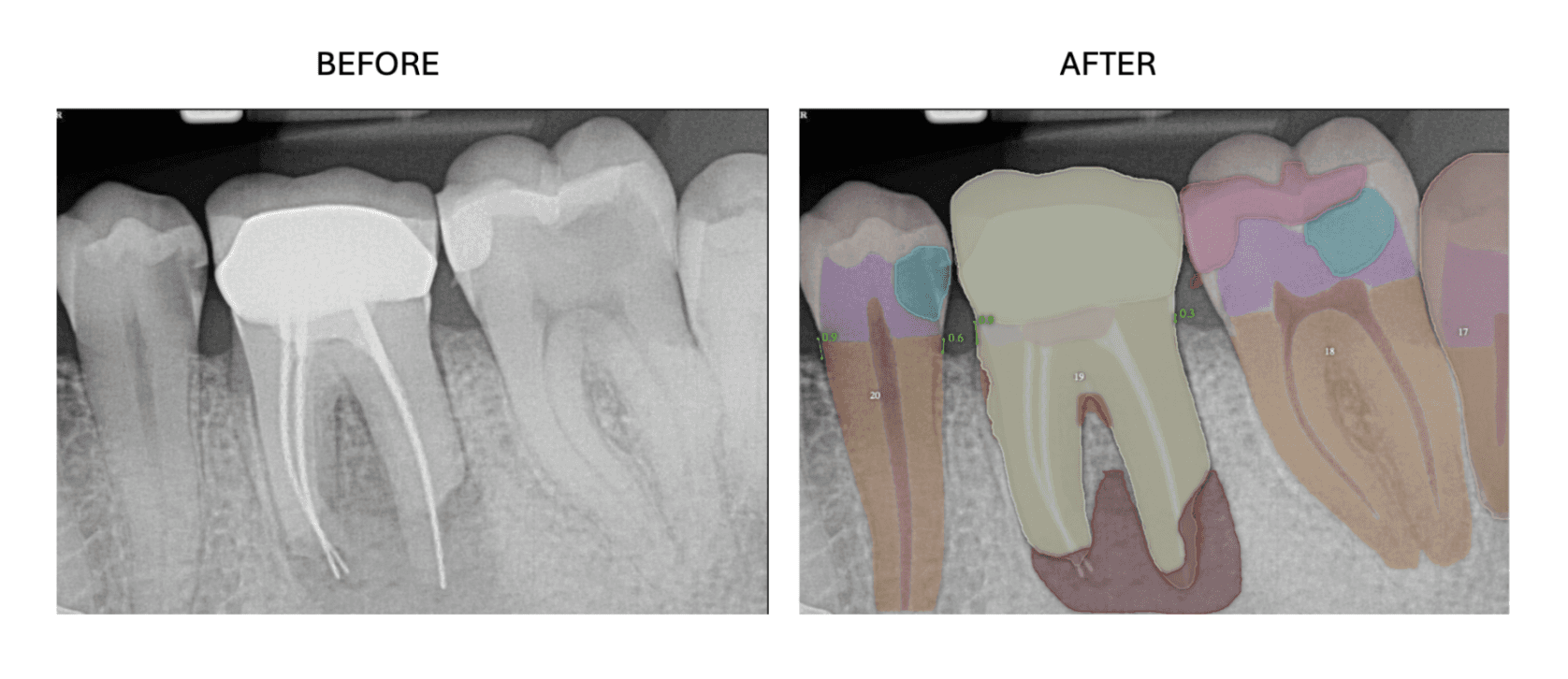
Periapical (PA) radiographs are one of the most commonly used diagnostic tools in dentistry. Dentists rely on them daily to detect caries, restorations, implants, missing teeth, and fixed prostheses. However, image interpretation can sometimes be challenging due to overlapping anatomical structures, image artifacts, and subtle pathological changes.
The purpose of this study was to determine whether a deep learning model could accurately identify multiple dental features and produce results comparable to expert human interpretation. Importantly, the authors emphasize that AI is intended to support clinicians not replace them by serving as an intelligent diagnostic assistant.
How the Study Was Conducted
Researchers collected 1,000 anonymized periapical radiographs from the University of Mississippi Medical Center, with 500 carefully selected images included in the final analysis. Each radiograph was independently reviewed by two experienced oral and maxillofacial radiologists, who established the clinical reference standard.
The AI system was evaluated for its ability to detect:
Teeth
Dental caries
Dental implants
Restorations (including amalgam and composite fillings)
Fixed dental prostheses (FDPs)
Missing teeth
Agreement between the AI and the expert radiologists was measured using Pearson correlation coefficients, a standard statistical method for evaluating consistency.
Key Findings
The results demonstrated strong agreement between the AI system and expert observers across every evaluated category.
Dental Implants: R = 0.97–0.98
Fixed Dental Prostheses: R = 0.92–0.94
Restorations: R = 0.85–0.89
Missing Teeth: R = 0.82–0.85
Dental Caries: R = 0.70–0.73
The highest agreement was seen in implant detection, which is expected because implants are highly radiopaque and clearly visible on radiographs. Caries detection, while still showing strong correlation, achieved the lowest score among the evaluated categories. This reflects a well-known clinical challenge, as early-stage carious lesions can be subtle and are sometimes difficult to identify even for experienced clinicians.
What These Results Mean for Dental Practices
The findings reinforce the growing role of AI as a valuable clinical decision-support tool. Rather than making diagnoses independently, AI can assist dentists by highlighting potential findings that deserve closer examination.
AI-assisted radiograph analysis offers several practical advantages:
Improves diagnostic consistency across clinicians.
Helps identify findings that might otherwise be overlooked.
Supports patient education by providing visual explanations.
Reduces repetitive manual review of radiographs.
Enhances documentation and overall workflow efficiency.
These benefits can help dental professionals focus more time on patient care while maintaining confidence in their diagnostic process.
VELMENI’s Role in AI-Powered Dentistry
The AI evaluated in this study is part of the broader VELMENI Dental AI Software ecosystem, designed to integrate seamlessly into everyday dental workflows.
VELMENI combines AI-powered radiograph analysis with workflow optimization, helping practices detect findings more efficiently while supporting clinical documentation, patient communication, and integration with imaging and practice management systems. By assisting rather than replacing clinicians, VELMENI aims to improve both diagnostic confidence and operational efficiency.
Understanding the Study’s Limitations
Like all scientific research, this study has limitations that should be considered.
Although researchers initially collected 1,000 radiographs, only 500 images met the inclusion criteria for analysis. In addition, all images originated from a single institution, meaning larger and more diverse datasets will be necessary to further validate the findings across broader patient populations.
The authors also recommend expanding future research to include three-dimensional imaging, such as CBCT, to evaluate AI performance across more complex diagnostic scenarios.
Final Thoughts
Artificial intelligence is becoming an increasingly important part of modern dental imaging, but successful adoption depends on rigorous clinical validation. This study demonstrates that the evaluated AI achieved performance comparable to experienced oral radiologists across multiple diagnostic tasks, particularly in detecting implants, restorations, fixed prostheses, and missing teeth.
While additional research involving larger and more diverse datasets is still needed, these findings highlight the growing potential of AI to improve diagnostic consistency, clinical efficiency, and patient communication. As evidence continues to grow, solutions like VELMENI Dental AI Software represent an important step toward integrating trustworthy, evidence-based AI into everyday dental practice.
rtificial intelligence is becoming an essential part of modern dental care. By combining advanced image analysis, automated measurements, patient-friendly reporting, and practice-level insights, VELMENI empowers dentists to work more efficiently while providing patients with greater clarity and confidence in their treatment.
As dental technology continues to evolve, AI-powered radiograph analysis is helping practices deliver more consistent diagnoses, stronger patient communication, and a smarter, more connected clinical workflow.